
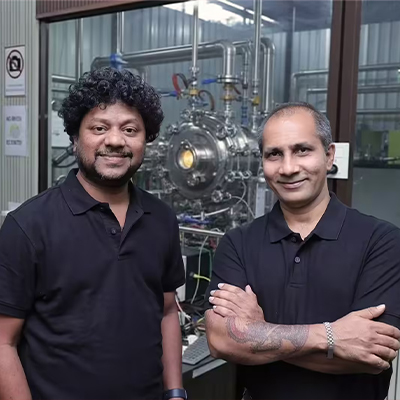
At Capital-A, the focus is on backing founders who combine deep engineering expertise with a practical, problem-solving mindset and a strong commercial orientation. Enerzi Microwave Systems, a clean hydrogen manufacturer, fits this thesis well by addressing a critical need in the global clean energy transition.
Enerzi has developed an innovative process to produce hydrogen using methane plasmolysis, which does not release CO₂ or consume precious water, while remaining highly energy efficient. The system uses microwave energy to split methane into hydrogen and solid carbon nanomaterial (CNP), enabling cleaner, more economical, and environmentally sustainable hydrogen production with a valuable carbon co-product.
Gaps In Current Hydrogen Solutions
India produces about 6 million metric tons (MMT) of hydrogen annually, almost entirely grey hydrogen from fossil fuels via steam methane reforming, which releases large volumes of CO₂.
As industries like steel, cement, fertilizers, and heavy transport pursue decarbonization, the need for cleaner hydrogen production pathways is becoming increasingly urgent.
The National Green Hydrogen Mission (NGHM)
- Targets 5 MMT of annual green hydrogen production capacity by 2030, supported by an investment outlay of ₹19,744 crore, including ₹17,490 crore under the SIGHT program, plus funding for pilot projects, R&D, and other components.
- The mission aims to mobilize around ₹8 lakh crore of investments, create approximately 6 lakh jobs, and reduce CO₂ emissions by about 50 MMT per year by 2030.
However, existing production technologies face limitations.
Economics and Limitations of Grey/Green/Blue current method
- Grey hydrogen costs around $1.92–$2.43/kg but carries a high carbon footprint.
- Green hydrogen via electrolysis requires about 45–55 kWh of electricity per kilogram, high-purity water, and capital expenditure exceeding $1.5M for a 60-ton-per-year plant, resulting in costs of roughly $4.6–$6.6/kg—nearly three times that of grey hydrogen.
- Blue hydrogen attempts to capture CO₂ from conventional reforming, but current methods often have low capture efficiencies, limiting widespread adoption.
Enerzi’s Methane Plasmolysis Approach
Enerzi addresses these challenges through methane plasmolysis, a process that uses high-energy microwaves instead of combustion or steam to split methane into hydrogen gas and solid carbon powder, with no CO₂ released into the atmosphere. The solid carbon is captured as high-purity carbon nano black (90%+ purity), a valuable input for applications such as batteries, tires, and electronics.
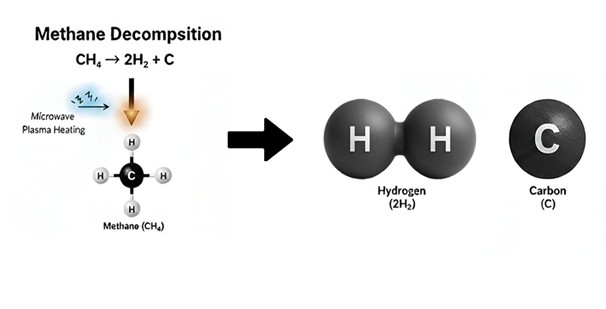
What is Plasmolysis?
Microwave plasmolysis employs high-frequency microwave energy to generate plasma, a superheated, electrically charged state of matter that efficiently breaks methane molecules into their constituent elements. This approach offers precise energy control, rapid operation, and lower thermal losses relative to conventional high-temperature systems.
In simple terms, methane (CH₄) consists of one carbon atom and four hydrogen atoms. Under intense plasma heating, these bonds break, yielding hydrogen gas and solid carbon, without emitting CO₂. This provides a pathway to clean hydrogen production that also produces a commercially valuable carbon co-product.
Why This Matters For India
Enerzi’s technology offers several key benefits particularly suited to the Indian context:
- Lower electricity consumption, targeting roughly one-third of the energy used in typical green hydrogen production.
- A water-free process that avoids the consumption of scarce clean water resources.
- Two revenue-generating outputs—hydrogen and solid carbon—enhancing overall commercial viability.
- Modular, scalable systems that can be deployed near end users, making it easier to integrate into existing industrial ecosystems.
Team And Execution Edge
Enerzi is led by founders Dr. Prakash Mugali and Kirankumar Hittalmani, both experienced in industrial microwaves and hydrogen systems. They bring decades of hands-on engineering work and have built a profitable legacy business, successfully translating lab-scale microwave technologies into industrial applications and securing letters of intent (LOIs) from major customers.
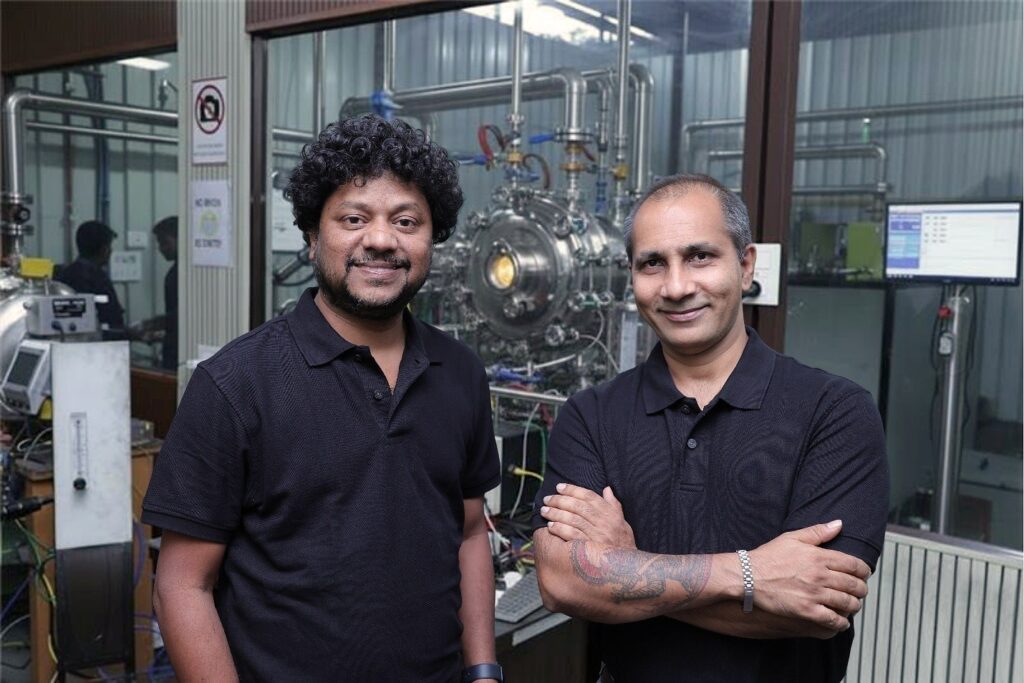
Dr. Prakash has been designing and commercializing microwave heating equipment since 2007, while Kiran has extensive experience at Bosch working on hydrogen engine systems. Together, they have assembled a team that understands both the underlying science of microwave plasmolysis and the operational realities of manufacturing at scale.
We at Capital-A are actively tracking climate tech, advance manufacturing, and deep tech sectors, backing the next generation of founders building for the future. If you are an operator, founder, or an investor in Climate Tech, Deep Tech or Manufacturing space, we would love to chat.
Please feel free to reach out to ankit@capital-a.vc, aswani@capital-a.vc & rakshith@capital-a.vc.