
Procore – a provider of a cloud-based construction management platform, is an interesting use case in SaaS and vertical software plays. It filed its S-1 in 2020 and IPO’d in the ZIRP frenzy in 2021, with a market cap of $631 million whilst having $289M in revenues that fiscal year. The interesting story is that in 3 years, they’ve been able to float at a market cap of $9.8 Billion and grown to $950M in subscription fees. Prior to their listing in 2021, Procore raised 7 rounds of venture capital from the likes of Bessemer Venture Partner, ICONIQ Capital, Tiger Global Management amongst other backers.
Get Aditya Singh’s stories in your inbox
Join Medium for free to get updates from this writer.
Here are a few Interesting takeaways on the broader ‘vertical SaaS’ theme :
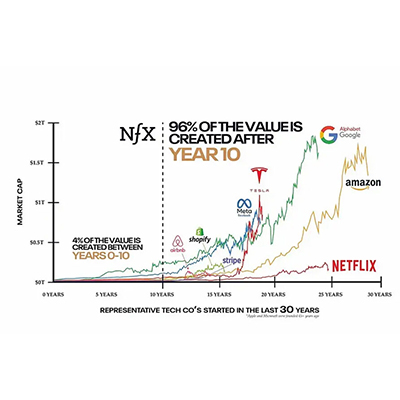
- Procore took about 10 years to reach $10M ARR, it took them less than 10 years since, to reach $1B in ARR. This means, the majority of the value creation kicks in with vintages exceeding 10 years in large scale SaaS ventures. Impetus is on investors to capture greater value in such markets as long as they strive to live by their moniker of providing ‘patient-risk capital’. A good case in point could be the timing of Softbank’s stake sale in Nvidia back in 2019. They exited their 4.9% stake, raking in $3.3B in profits. However, if they stayed the course and were locked in through Nvidia’s rise to the top, their position would have been worth $150B, a 45X multiple delta. Indeed, Mayoshi Son was right when he addressed this deal as ‘the fish that got away’.
- Because of early double digit growth rates in %points in such businesses, it was commonly perceived that vertical SaaS may not fructify into ‘Venture outcomes’. Here’s a graph that has a contrarian insight:
- While looking at “verticals”, digitization and adoption of technology is not linear. To put it this way, In a tech-centric business, such as one involving developers/SDEs/SREs, the adoption of development tools happens more quickly compared to industries with archaic molds like construction, where divisional/vertical department head tends to transition to new technology more gradually, replacing established practices over time.
This disparate adoption behavior must be factored in whilst underwriting a SaaS venture. What we should ideally pay attention to is to assess the propensity and velocity of adoption which is a function of the need-gap being solved for. Incidental migration complexities, cost of switch and stickiness of embedding in work-flows are also important factors.
- Despite trading at $10B in market capitalisation, Procore has still captured a sub-12% of US Average construction value. The 12% capture translated to $1B is SaaS billings. If the segment is penetrated vertically, the quest for being the majoritarian consolidator may not be as elusive. While the gestation to reach scale was longer, there is merit in exploring ways to integrate vertically across the focus segment’s process flows in order to become a critical tool and have scope to iterate products and upsell further.
- That said, what could drive conversion and adoption could be: having a curtailed and nuanced GTM approach while interacting with different personas of the vertical’s value chains.
- The vertical integration here emanates from Pre-construction planning > execution > workforce management > financial management. End to-end lifecycle of a project is captured, and this could be the model to go after.
- The next obvious question beckons, where does the enterprise get the 10–100 expansion boost from? The short answer is to add horizontal offerings such: as Fintech plays OXYZO > Ofbusiness, Shopify Capital > Shopify, B2B Marketplace and financing plays like Zetwerk & Cars24, HRMS bundled with employee benefits- insurance & well-being, logistics tech + working capital financing> Shiprocket. While the core value proposition remains to serve a verticalized segment focus, at scale, growth is accentuated by offering products/services through horizontal integrations.
- These businesses also have the economies of scale flywheel kick in their life cycles. As more product functionalities are added, it enables higher monetization and as a result increases ARPA: Average revenue per account. Better ARPAs result in justifiable CAC/LTV as the stickiness increases once the user builds habitual workflow dependencies.
- Hubspot (NYSE: HUBS) saw its ARPA increase from $10,047 in 2019 to $11,365 in Q4 2023. Their operating cash flows grew from $119M to $351M in the same period. Hubspot’s core value proposition emanated from marketing-automation for SMBs, which they were able to build upon and now offer a loaded-CRM which solves for marketing automation, sales management and content management, streamlining sales and marketing efforts. They were able to upsell and cross-sell by embedding into critical processes of these businesses and that increased their stickiness.
With deeper penetration of digitization across myriad sects of economies, cost and access to data on a downward price curve and uptick in compute abilities of AI > AGI models, vertical SaaS is here to stay and seems to be the natural progression frontier in terms of technology artilleries of enterprise leveraging the advancement and adoption of artificial intelligence.